
আরও দেখুন


 20.01.2026 12:54 PM
For the second consecutive day, the U.S. Dollar Index has remained under pressure as tensions between the United States and the European Union continue to escalate. Although Brussels attempted to ease the situation yesterday, overall conditions remain tense and, most importantly, uncertain.
Typically, in such circumstances the dollar enjoys increased demand thanks to its safe-haven status. But not this time. The retaliatory measures being discussed have frightened dollar bulls, causing the greenback to weaken across the board.
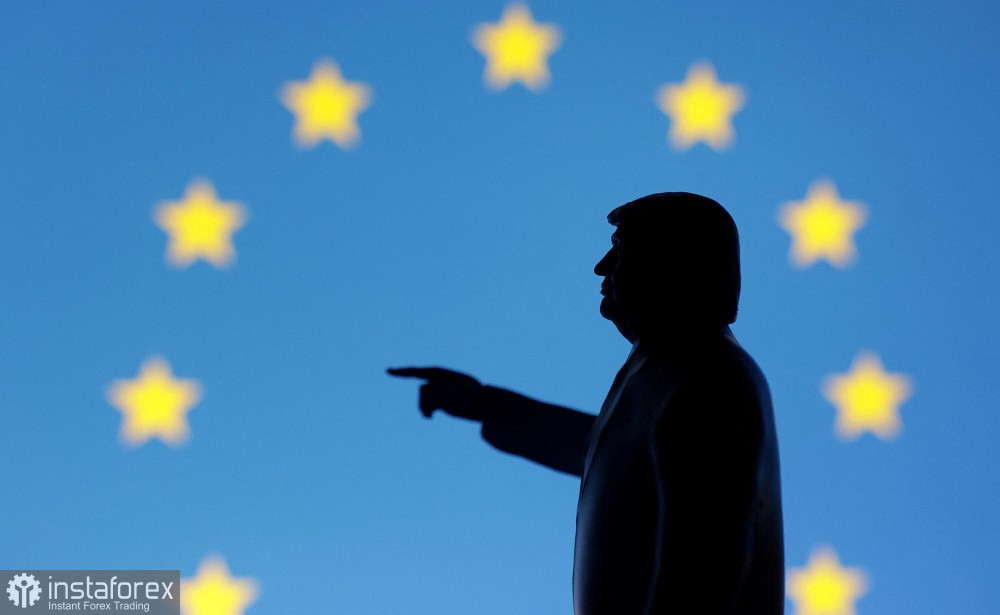
Everything began when Donald Trump announced the introduction of an additional 10% tariff on a number of European countries starting February 1. According to the U.S. president, if a deal to purchase the Danish island is not finalized by June 1, the tariff rate will be increased to 25%.
The European side, in turn, has allowed for the possible use of the so-called Anti-Coercion Instrument (ACI) against the United States. This mechanism enables the EU to block access to a large portion of the single European market. At the same time, existing international agreements would be ignored, with priority given to the ACI.
Although this "trade bazooka" could cause serious damage to the European Union itself, EUR/USD traders are primarily focused on the potential consequences for the United States. The ACI could hit entire sectors of the U.S. economy (digital services, pharmaceuticals, aviation, finance) through tariffs, restrictions on access to the EU market and public procurement, as well as regulatory pressure on American corporations. This would increase corporate costs, intensify the fragmentation of transatlantic trade, and ultimately could have a negative impact on investment and supply chains.
Against this backdrop, the dollar is weakening across the market—first and foremost due to rising strategic uncertainty surrounding the United States. The very fact that the EU is ready to use the Anti-Coercion Instrument (a mechanism that has never been applied before) is forcing traders to reassess the long-term sustainability of U.S. economic dominance. This is encouraging a shift away from dollar-denominated assets toward more diversified instruments. The "safe-haven" status does not work in this case, as the American "harbor" itself is bracing for stormy turbulence.
That is why the attention of EUR/USD traders is now focused on Davos, Switzerland, where the World Economic Forum began yesterday. During the forum, Trump is expected to meet with European leaders, where he will likely reiterate his plans to establish U.S. control over Greenland.
After the Davos forum, EU leaders will convene an emergency summit to formulate a pan-European response to the United States. According to European Commission President Ursula von der Leyen, "the European Union will stand firm in its commitment to protect Greenland." France, for its part, according to Le Monde, is insisting on the use of the above-mentioned Anti-Coercion Instrument against the United States. Whether the other EU leaders will support Emmanuel Macron (in this case, a qualified majority rather than unanimity is required) remains an open question.
It can be assumed that following the Davos forum, events will unfold according to an escalation scenario rather than the opposite. According to a number of media outlets, Trump is heading to Davos in an "aggressive and ambitious mood" and does not intend to make any concessions on the "Greenland case." In particular, last night he posted yet another image on his social network related to his territorial claims, in which he asserted rights not only to Greenland, but also to Canada.
Some analysts believe that "collective verbal therapy" from the Europeans could have a calming effect on Trump—meaning that the situation would return to a negotiating framework and ultimately end in some form of compromise. For example, this could involve strengthening the U.S. presence in the Arctic, including Greenland, within NATO, and/or U.S. participation in regional security and resource development projects in exchange for guarantees of respect for Denmark's sovereignty.
Previously, Trump's threats have repeatedly been either put on hold or canceled altogether (or their content has been altered), so such a scenario cannot be ruled out.
However, according to the majority of experts, the Davos forum will not reduce tensions—on the contrary, further developments are likely to be escalation-driven.
In other words, the risks of Brussels using the "trade bazooka" remain, as do the risks of retaliatory measures from the United States.
Markets are interpreting the current situation against the greenback and are following the "Sell America" principle, which has put the dollar under extremely strong pressure. The EUR/USD pair, in turn, is rising rapidly, updating multi-day price highs. However, such a swift rise ahead of such a significant event (the Davos talks with Trump) does not inspire confidence—because if, contrary to gloomy forecasts, the parties issue "conciliatory" statements, the pair could fall just as rapidly back toward the 1.16 level. In conditions of such turbulence—and, above all, uncertainty—it is advisable to maintain a wait-and-see stance on the EUR/USD pair.


