
Vea también


 20.01.2026 12:25 AM
It should also be noted that on January 14, negotiations were held between representatives of Denmark and the United States regarding the status of the Arctic territory, 90% of which is covered by perpetual ice. After the meeting, it became clear that the parties held radically opposite views, which hardly surprised anyone. No agreement was reached, although it is unclear to me what could have been negotiated, given that Trump wanted to get the island at any cost, and Denmark is not willing to concede or even sell its territories to anyone.
And here we smoothly return to 2025, when Donald Trump first introduced tariffs on goods from the European Union. If you recall, I repeatedly said that a trade deal with Donald Trump guarantees absolutely nothing. Presumably, in Brussels, they thought that placating the American president once with a completely onerous (for themselves) trade deal would prevent further problems with America. At this point, I personally want to laugh. Throughout 2025, I said that Trump would continue to expand his geopolitical, financial, and trade ambitions. Trump is a businessman who holds serious cards. What can Denmark or, even more so, Venezuela oppose to the military power of the United States and its financial capabilities? Moreover, many countries worldwide, including European ones, receive substantial revenue from the American market. And Trump, understanding this, uses tariffs as his main lever of pressure.
However, this time, I think the European Union already understands that it needs to respond to Trump as Beijing did: tit for tat. Beijing was the only one to strike the US with proportionate blows. And the EU this time may stop playing the role of the "punching bag." Brussels is already prepared to impose tariffs on American imports totaling about $90 billion. In addition, a special mechanism limiting investment in the US economy could come into effect, seriously complicating the operations of American companies in the European market. Europe has the ability to respond blow for blow; the problem is that Europeans want to live quietly and peacefully, without direct confrontation.
However, the EU's softness this time may not only cost it financially. If a year ago the issue was hundreds of billions of dollars that Europe should invest in the American economy and buy energy from the US, now the issue concerns territorial integrity. European politicians are united in the view that territory cannot be a subject of any negotiations. Therefore, Trump's new tariffs will remain in force and will later rise to at least 25%. Brussels has no choice but to respond with tariffs. The question is only whether this will be a blow that forces Trump to abandon his Arctic ambitions, or merely a shot from a slingshot at a passing freight train.
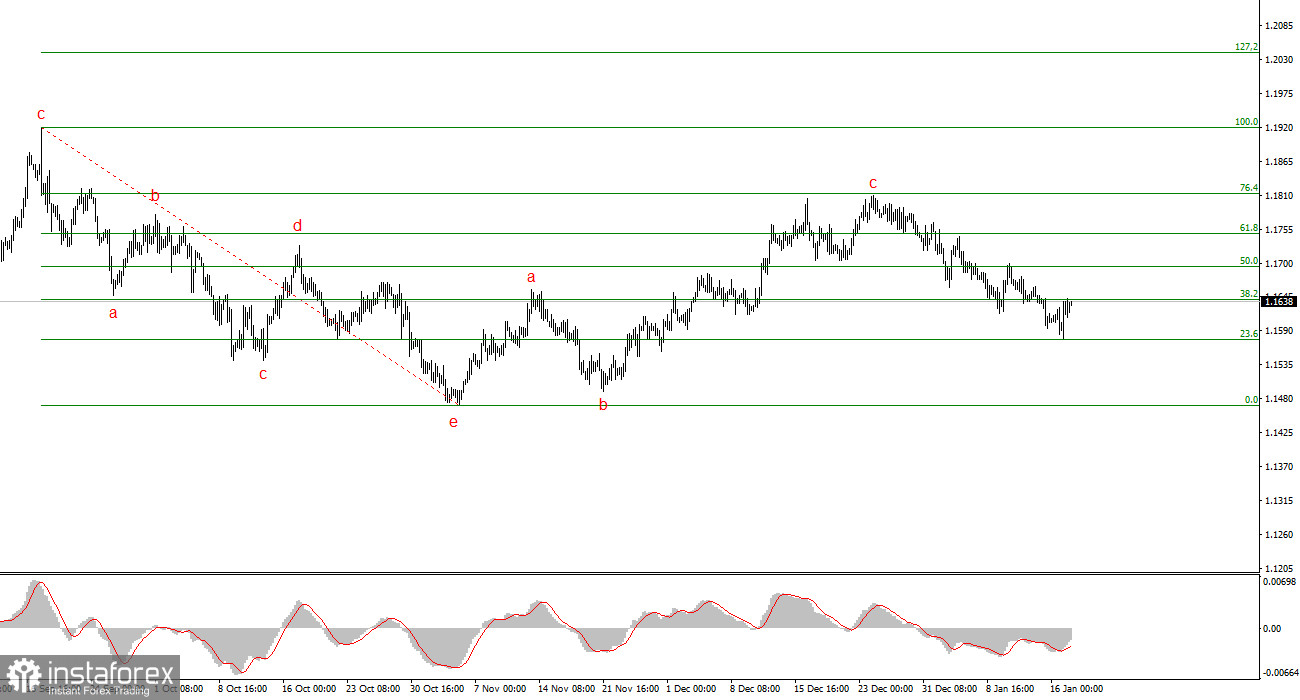
Based on the analysis of EUR/USD, I conclude that the instrument continues to build an upward section of the trend. Trump's policy and the Fed's monetary policy remain significant factors in the long-term decline of the US dollar. The targets of the current trend section may extend up to the 25th figure. However, to reach those targets, the market must complete the construction of an extended wave 4. Right now, we see only the market's desire to continue that wave. Therefore, in the near term, a decline to the 15th figure can be expected.
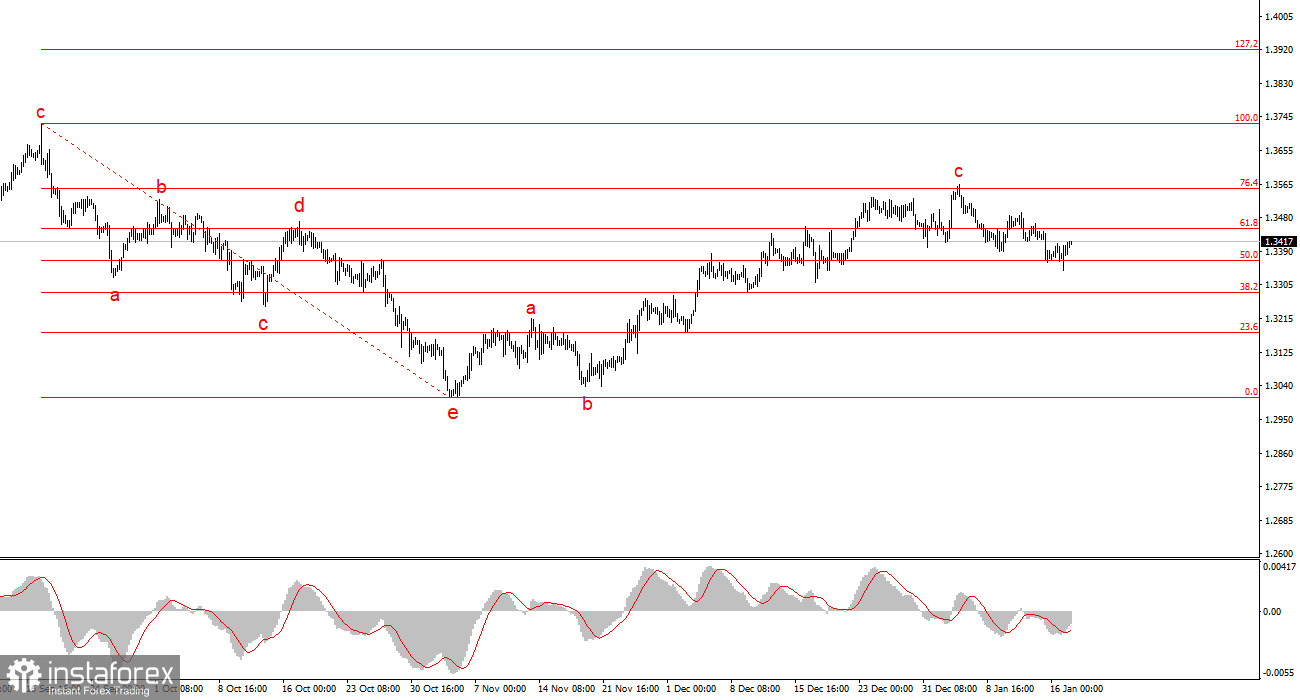
The wave picture for GBP/USD has changed. The downward corrective structure a-b-c-d-e in C within wave 4 looks complete, as does wave 4 itself. If this is indeed the case, I expect the main trend section to resume with initial targets around the 38 and 40 figures.
In the short term, I expected wave 3 or c to form, with targets around 1.3280 and 1.3360, which correspond to 76.4% and 61.8% by Fibonacci. These targets have been reached. Wave 3 or C has presumably completed, so in the near term, a downward wave or a set of waves may form.


