
Vea también


 05.12.2025 01:50 PM
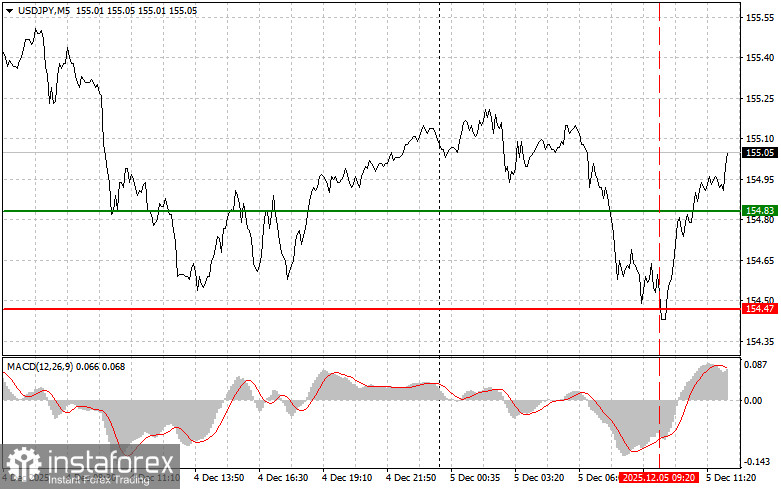
The test of the price level at 154.47 occurred when the MACD indicator had already moved significantly below the zero mark, which limited the pair's downside potential. For this reason, I did not sell the dollar. Unfortunately, I did not wait for a second test to buy at this level.
In the afternoon, particular attention will be paid to the release of US data. It will start with the Personal Consumption Expenditures (PCE) index, followed by information on changes in consumer spending and income. Later that day, consumer sentiment data calculated by the University of Michigan and inflation forecasts prepared by the same organization will be published. The PCE index presented here is an important inflation indicator that the Federal Reserve closely monitors. Today's data is expected to provide a more accurate assessment of the inflation trajectory and may influence the Fed's future interest rate decisions. A strong decline in the index will certainly allow the Fed to cut interest rates next week.
The Consumer Sentiment Index, calculated by the University of Michigan, is an important indicator reflecting consumer expectations and perceptions of the current and future economic situation. A decline in this index will lead to depreciation of the US dollar against the Japanese yen, and given the expected differences in monetary policy between the two countries, pressure on the USD/JPY pair will return quickly.
For the intraday strategy, I will focus on implementing Scenarios 1 and 2.
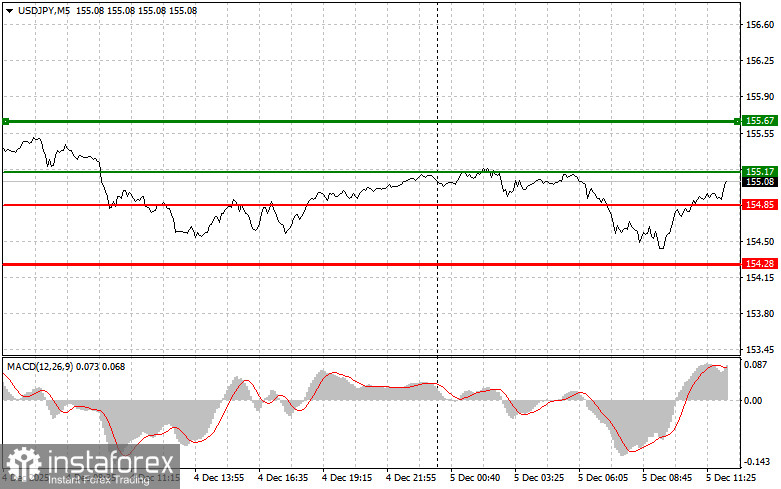
Scenario No. 1: I plan to buy USD/JPY today upon reaching an entry price around 155.17 (green line on the chart), targeting a move to 155.67 (thicker green line on the chart). At around 155.67, I will exit my long positions and sell immediately in the opposite direction, aiming for a movement of 30-35 pips from the entry point. Growth in the pair can only be expected after strong US data. Important! Before buying, ensure the MACD indicator is above the zero mark and just starting to rise from it.
Scenario No. 2: I also plan to buy USD/JPY today if there are two consecutive tests of 154.85 while the MACD indicator is in the oversold area. This will limit the pair's downside potential and lead to an upward market reversal. We can expect growth toward opposing levels of 155.17 and 155.67.
Scenario No. 1: I plan to sell USD/JPY today after the 154.85 level is updated (red line on the chart), which will trigger a rapid decline in the pair. The key target for sellers will be the level of 154.28, where I will exit my shorts and immediately buy in the opposite direction, aiming for a movement of 20-25 pips in the opposite direction from that level. Pressure on the pair will only return in the case of very weak US data. Important! Before selling, ensure the MACD indicator is below the zero mark and just starting to decline from it.
Scenario No. 2: I also plan to sell USD/JPY today if there are two consecutive tests of 155.17 while the MACD indicator is in the overbought area. This will limit the pair's upward potential and lead to a market reversal downward. We can expect a decline to the opposing levels of 154.85 and 154.28.
Beginner traders in the Forex market need to be very cautious when making decisions to enter the market. It is best to stay out of the market before the release of significant fundamental reports to avoid sharp fluctuations in the exchange rate. If you decide to trade during news releases, always set stop orders to minimize losses. Without setting stop orders, you can quickly lose your entire deposit, especially if you do not use money management and trade large volumes.
Remember that successful trading requires a clear trading plan, like the one presented above. Impulsive trading decisions based on the current market situation are fundamentally a losing strategy for intraday traders.


