
यह भी देखें


 12.03.2026 08:34 AM
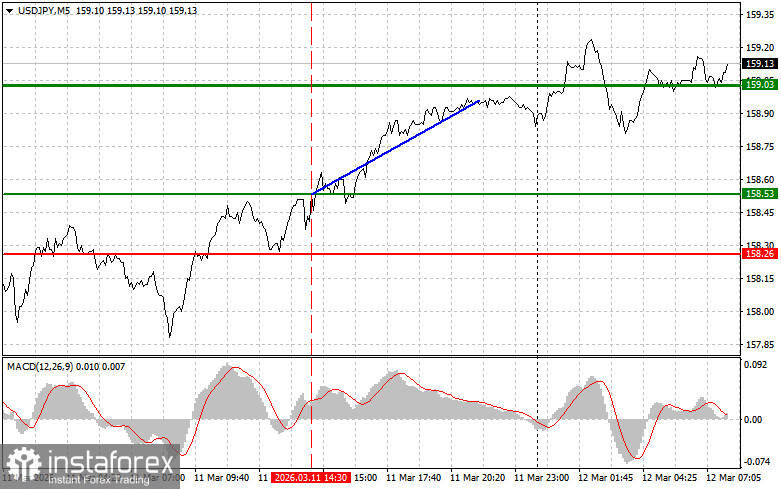
The price test at 158.53 occurred when the MACD indicator was just beginning to move upward from the zero mark, confirming the correct entry point for buying the dollar. As a result, the pair increased by 40 pips.
The U.S. dollar is demonstrating a decisive rise against the yen. Yesterday's data showing a 0.3% increase in the U.S. Consumer Price Index (CPI) led to further growth of USD/JPY toward the 159 level, where the Bank of Japan may usually intervene in the pricing process. This level has long been a focus for the central bank, which has repeatedly hinted at its readiness to take steps to curb excessive weakening of the national currency.
The acceleration of inflation in the United States, even at moderate rates, fuels expectations regarding further actions by the Federal Reserve. Markets are assessing the likelihood of U.S. interest rates remaining high for longer, creating a favorable environment for the dollar's appreciation.
However, as the pair approaches the 159 mark, it may prompt the Bank of Japan to increase its interventions. Historically, such levels have served as signals for Japanese authorities to sell dollars and buy yen to stabilize the exchange rate. In the event of regulatory intervention, one can expect a sharp trend reversal and a downward correction.
Regarding the intraday strategy, I will continue to rely on the implementation of scenarios #1 and #2.
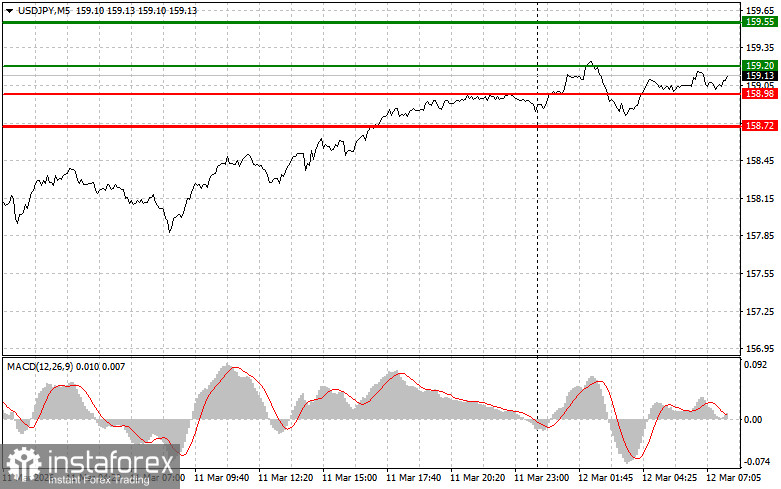
Scenario #1: I plan to buy USD/JPY today when the price reaches an entry point around 159.20 (the green line on the chart), targeting a move to 159.67 (the thicker green line on the chart). At around 159.55, I plan to exit the long positions and sell immediately on the rebound (expecting a move of 30-35 pips in the opposite direction from the level). It is best to return to buying the pair on corrections and significant declines in USD/JPY. Important! Before buying, ensure the MACD indicator is above the zero mark and just starting to rise from it.
Scenario #2: I also plan to buy USD/JPY today if there are two consecutive tests of the price 158.98 when the MACD indicator is in the oversold area. This will limit the pair's downside potential and lead to an upward market reversal. One can expect growth to the opposite levels of 159.20 and 159.55.
Scenario #1: I plan to sell USD/JPY today only after a retest of the 158.98 level (red line on the chart), which will trigger a rapid decline in the pair. The key target for sellers will be the level of 158.72, where I intend to exit the short positions and immediately buy in the opposite direction (expecting a move of 20-25 pips in the opposite direction from the level). It is better to sell as high as possible. Important! Before selling, ensure the MACD indicator is below the zero mark and just starting to decline from it.
Scenario #2: I also plan to sell USD/JPY today if there are two consecutive tests of the price 159.20 when the MACD indicator is in the overbought area. This will limit the pair's upside potential and lead to a downward market reversal. One can expect a decline to the opposing levels of 158.98 and 158.72.
Important: Beginner traders in the forex market need to make entry decisions very carefully. It is best to stay out of the market before the release of important fundamental reports to avoid sharp fluctuations in prices. If you choose to trade during the release of news, always set Stop Loss orders to minimize losses. Without placing Stop Loss orders, you can quickly lose your entire deposit, especially if you do not use money management and trade large volumes.
And remember, successful trading requires a clear trading plan, like the one presented above. Making spontaneous trading decisions based on the current market situation is inherently a losing strategy for intraday traders.

